
Log entry 08: Grinding & surface preparation
Grinding: the cut that removes almost nothing, on purpose
Every other entry in this log separates concrete. Grinding shaves its surface. A diamond grinder takes off high spots a fraction of an inch at a time, which makes it the right tool for three jobs a saw cannot do: erasing the lip where one sidewalk panel has heaved above the next, leveling the ridge a patch or a slab edge left behind, and stripping a floor's old coating, glue, or paint so a new finish can bond. It is slow, dusty work when done dry, and precise work when it is set up right.
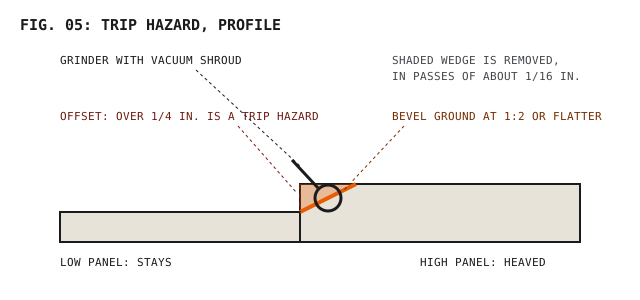
Trip hazards: the quarter-inch rule
Federal accessibility standards treat a vertical change in level on a walking surface over 1/4 inch as a trip hazard. Between 1/4 and 1/2 inch, the change may be beveled at a slope no steeper than 1:2; beyond 1/2 inch it is handled as a ramp or as replacement, not as a grind. New England winters manufacture these lips: frost heave and tree roots lift one panel, the neighbor stays put, and by spring the walk to the front door has a toe-catcher in it. Municipal sidewalks, school and campus walks, apartment and condo paths, and storefront entries carry the same exposure, and the liability sits with whoever owns the walk.
- Grinding fits when the offset is roughly 2 inches or less, the panel is sound (no cracking through, no spalling, no rocking), and the surface can spare the material. The result is a beveled ramp at the joint, ground in one visit, with no forms, no pour, and no cure time.
- Replacement fits when the panel is cracked through, settled below grade (a ponding birdbath), or heaved beyond grinding range. Grinding a dead panel is money on a corpse; the removal log covers that scope.
- The cause matters. A live tree root keeps pushing. Grinding buys years, not forever, and an honest quote says which it is buying. Root work and panel work are sometimes sequenced together.
Surface preparation: the other half of grinding
Garage, basement, warehouse, and retail floors get ground for a different reason: a coating or overlay bonds to the surface it is given. Diamond grinding removes old paint, thin-set, carpet glue, curing compounds, and the soft, weak laitance on new concrete, and it opens a surface profile the new material can grip. The prep is specified by profile, not by eye: light for sealers, deeper for epoxy and overlay systems, per the coating maker's instructions. Skipping prep is the standard reason a two-year-old epoxy floor peels in sheets.
How the work runs
- Survey and mark. Every offset is measured (a straightedge and a gauge, not a guess) and marked with its height. Panels that fail the soundness test are flagged for replacement, not ground.
- Grind wet or vacuum-shrouded. Grinding makes fine dust fast, so the silica rules from the dust and slurry log apply in full: water where the setup allows it, or a HEPA vacuum shroud fitted to the grinder. Dry, open grinding is not an offered method.
- Blend the ramp. The bevel is ground back into the high panel at 1:2 or flatter, feathered so no new edge is created at the end of the pass.
- Verify and record. A straightedge across the finished joint shows the result; on municipal and commercial work, the before and after measurements are recorded per location.
Pricing, plainly. Trip-hazard grinding is priced per joint or per location, because the offset and the walk width set the work; floor grinding and prep are priced per square foot, because area sets it. Both sit in the rate card as planning ranges with their assumptions printed. The mobilization minimum applies to grinding visits exactly as it does to saw visits, which is why a property with nine lips should grind all nine in one visit.
Grinding questions land in the same place as cutting questions: request a connection and name the surface (a sidewalk joint, a garage floor, a storefront entry) and what is on it now.