
Log entry 02 — Flat & slab sawing
Flat sawing: straight lines in horizontal concrete
Flat (slab) sawing uses a walk-behind or ride-on saw with a diamond blade, cutting horizontal surfaces: floors, slabs-on-grade, driveways, sidewalks, bridge decks, and roadways. It is the fastest, straightest way to divide flat concrete — and the cut most likely to be scheduled wrong, because new concrete has a closing window.
Green concrete vs cured concrete — two different jobs
Green (early-entry) cutting
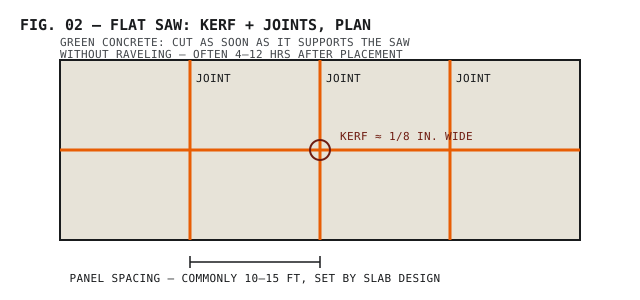
Fresh slabs are cut as soon as the surface supports the saw and operator without raveling the edges — commonly 4–12 hours after placement in warm weather, later in a Littleton January. Early-entry saws make shallow joints (typically 1 inch deep) that must be timed, not just scheduled: miss the window and shrinkage cracks pick their own path. Joint layout, pour sequence, and saw availability are planned together before the truck arrives.
Cured concrete cutting
Existing slabs are cut full-depth with larger saws — walk-behind for most floors and driveways, ride-on and diesel/electric saws for thick or heavily reinforced work. Interior work uses electric or hydraulic saws (no exhaust) with slurry containment; exterior work is usually gasoline or diesel with water for dust control. Depth capacity ranges from 4 inches on small saws to 24 inches or more on large flat saws.
The four jobs flat saws do here
- Control and contraction joints in new slabs, driveways, and walks — spacing commonly 10–15 ft in each direction, depth at least one-quarter of slab thickness for conventional saws.
- Trenching cuts: paired parallel cuts so a strip of slab can be lifted for plumbing, drain, electrical, or radiant work below, then patched back. The pair of cuts plus breakout is the real scope — price all three parts.
- Slab openings and removal prep: cutting a defined panel out of a floor for equipment bases, pits, elevator work, or failed-slab replacement.
- Curb, apron, and roadway cuts for driveway widenings, utility taps, and patch boundaries — clean edges patch better and last longer than broken edges.
Details that decide the result
Depth. Cutting short of full depth leaves a web that breaks raggedly; cutting through into the base is correct for removal, wrong over buried lines. Reinforcement. Mesh cuts easily; rebar slows the blade and wears it — both are priced in the ledger bands. Aggregate. Merrimack Valley gravels are hard and rounded; they cut slower than soft limestone regions, which is one reason national price lists understate Greater Boston work. Overcuts. A round blade leaves a tail past each corner; where corners must be crisp (finished openings), corners are finished by hand saw and the overcut plan is agreed before cutting.
Interior flat work is a slurry job first, a cutting job second. Water is required for silica control, so floors, drains, and finished spaces need containment, wet vacuuming, and a disposal plan before the saw starts. See dust, slurry & silica.
Per-linear-foot planning bands by thickness are in the cost ledger — slab sawing is one of the three Cut Planner modes. For vertical work, see wall sawing.