
Log entry 01 — Core drilling
Core drilling: round holes, cut wet, measured twice
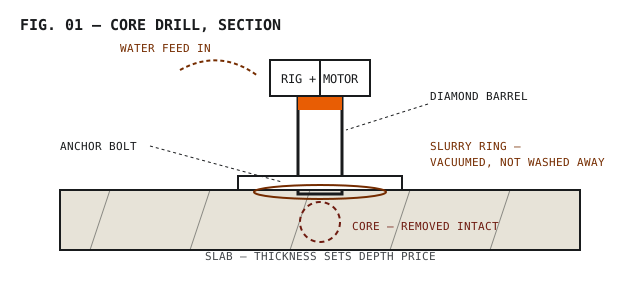
A core drill is a hollow diamond barrel turned by a rigid, anchored rig. It does not hammer. It grinds a clean annulus and leaves the center — the core — intact, which is why a cored hole has smooth walls, true diameter, and no spalled edges. Almost every pipe, conduit, vent, and drain that passes through concrete starts as a core.
Sizes, depths, and what they are for
| Diameter | Typical use in this area | Notes from the log |
|---|---|---|
| 1/2 – 2 in. | Anchor and rebar dowel holes, small conduit, radon test and mitigation piping, mini-split line sets | Small diameters can be hand-held or rig-mounted; rig work is straighter and safer overhead |
| 2 – 4 in. | 1½–3 in. plumbing, electrical conduit bundles, dryer and bath vents, sump and drain lines | The most common residential range. Size the hole to the fitting plus clearance — a 3 in. pipe does not go through a 3 in. hole |
| 4 – 8 in. | 4 in. sewer and drain, larger vents, HVAC sleeves, Title 5 septic pipe penetrations through foundation walls | Core weight grows fast: an 8 in. core in 8 in. concrete weighs roughly 55–60 lb. It must be controlled, not dropped |
| 8 – 18 in. | Manhole and catch-basin taps, large ducts, clustered penetrations, chimney and flue work | Rig anchoring and core handling dominate the job; stitch drilling (overlapping cores) covers shapes a single barrel cannot |
| 18 – 48 in. | Vault and utility structures, large culvert and tank openings | Specialty barrels and heavier rigs; engineered lifting for the core is routine, not optional |
Depth: through-cuts and blind holes
A standard barrel cuts about 12–14 inches per pass; extension barrels stack for deeper work — foundation walls of 8–10 inches, thickened slabs, and old mill footings of 24 inches or more are all routine. Depth is priced honestly: the ledger's base hole price covers the first 8 inches, then each added inch is a stated per-inch charge. Blind (non-through) holes for anchors and testing are drilled to a marked depth and the core is snapped and removed.
What the hole passes through matters more than the hole
- Plumbing: floor cores for drains must land on the trap and line below; layout comes from the plumber's measurements, verified against the scan.
- HVAC: refrigerant, condensate, and vent penetrations through walls and slabs; exterior wall cores need a slight outward pitch for condensate and weather.
- Electrical: conduit cores are the classic conduit-hits-conduit accident. Scanning first is standard practice, not an upsell.
- Septic / Title 5: coring a foundation or tank wall for inlet/outlet piping must preserve the wall's strength and seal with a proper boot or link seal — a hammered hole with foam around it is a leak with a date on it.
- Testing cores: engineers take cores to verify thickness and compressive strength. Those locations are chosen by the engineer and patched per specification.
Overhead and wall cores. Drilling up into a ceiling or horizontally through a wall adds rigging, water control, and core retention (the core must not fall on anyone). Expect wall and overhead work to price above the same hole in a floor — the ledger's planning ranges assume floor work unless stated.
Before any core is drilled
- Scan or verify. GPR scan (or drawings plus a cover meter) to mark rebar, conduit, and any tendon. If PT is possible, scanning is mandatory — see the scanning log.
- Layout and sign-off. Hole centers marked and initialed by whoever owns the layout — plumber, electrician, GC, or owner. A moved hole after drilling is a second hole at full price.
- Water and power. Wet drilling needs a water source and typically a 20-amp circuit or generator. Slurry is vacuumed as it is made.
- Dig Safe, if digging follows. Coring itself is not excavation, but the trench or pit it feeds usually is — 811 notice at least 72 hours ahead (weekends and holidays excluded) under Massachusetts law.
Planning prices for cores by diameter, with the depth rule printed: cost guide + Cut Planner. Ready to describe a job? Request a connection.